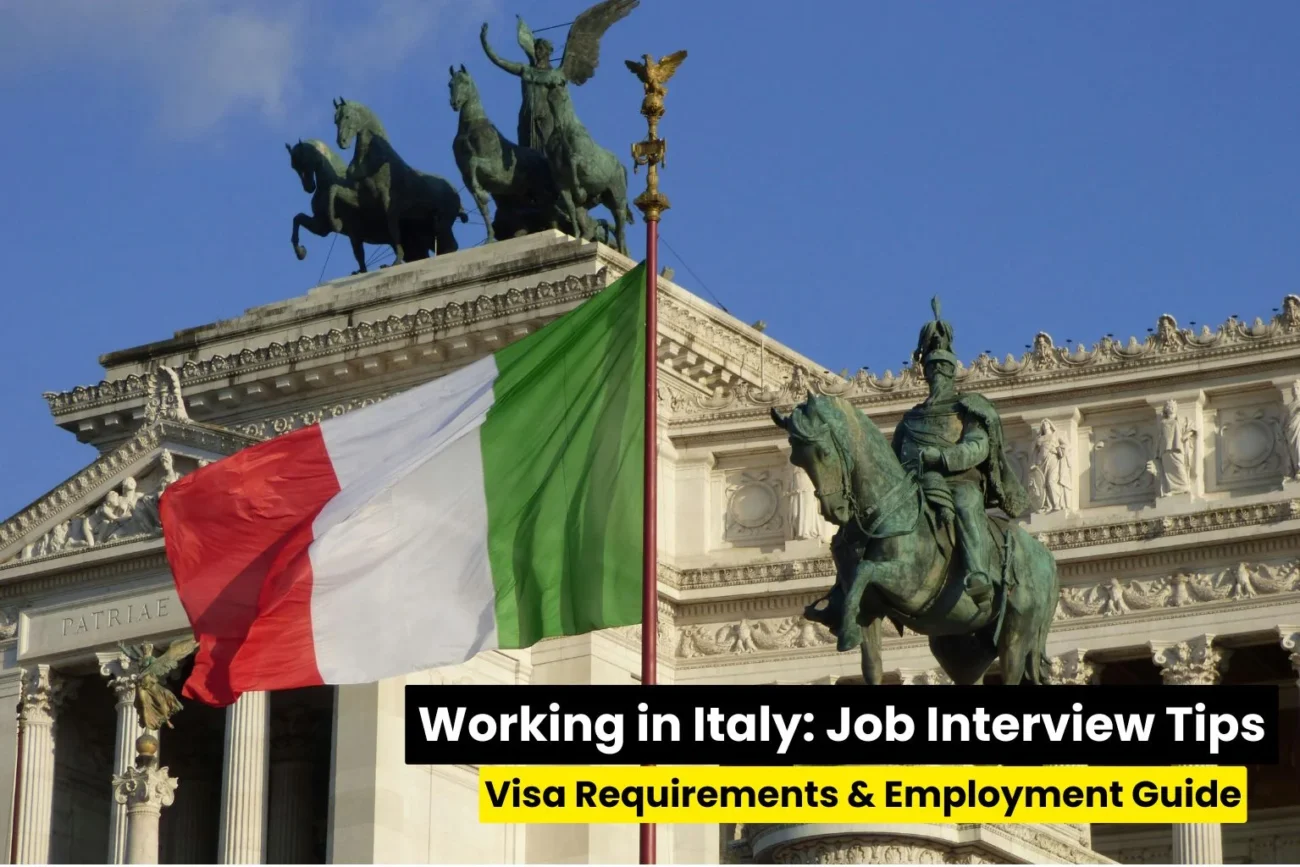
Italy continues to attract foreign workers looking for employment opportunities in Europe. From agriculture, construction and logistics to hospitality, healthcare, manufacturing and professional services, the Italian labour market offers jobs for people with different levels of education and experience.
For non-European Union applicants, however, getting a job in Italy involves more than simply sending a CV. Candidates need to understand how Italian employers recruit, how job interviews are conducted, what documents are required and, most importantly, how the Italian work visa and Nulla Osta process operates.
This guide explains how to find jobs in Italy, prepare for interviews, understand salary expectations, obtain a work visa and successfully complete the employment process in 2026.
Why Consider Working in Italy?
Italy can be an attractive destination for international workers for several reasons.
The country has a large and diversified economy with strong industries including manufacturing, tourism, agriculture, food production, construction, logistics, engineering, fashion and healthcare.
Seasonal employment is particularly important in agriculture and tourism, while industrial regions in northern Italy regularly recruit workers for factories, warehouses, construction companies and transportation businesses.
Italy also operates an official immigration quota system known as the Decreto Flussi, through which employers can recruit eligible workers from non-EU countries.
For the 2026–2028 period, the Italian government approved 497,550 entries for foreign workers, including 164,850 places for 2026. For 2026 specifically, the allocation includes 76,200 non-seasonal employed workers, 88,000 seasonal workers and 650 self-employed workers.
Another advantage is that workers employed legally in Italy receive protections under Italian employment law and the applicable national collective bargaining agreements.
Popular Jobs Available in Italy
Employment opportunities differ significantly depending on location, season, qualifications and Italian-language ability.
Some of the most commonly advertised positions include:
| Job/Industry | Common Positions | Approximate Monthly Pay |
|---|---|---|
| Agriculture | Farm worker, fruit picker, greenhouse worker | €1,000–€1,500+ |
| Hospitality | Waiter, kitchen assistant, hotel worker, cleaner | €1,000–€1,600+ |
| Construction | General labourer, mason, plumber, electrician | €1,300–€2,000+ |
| Manufacturing | Factory worker, machine operator, production worker | €1,200–€1,800+ |
| Warehousing | Warehouse worker, picker/packer, forklift operator | €1,200–€1,800+ |
| Driving | Delivery driver, van driver, truck driver | €1,400–€2,300+ |
| Caregiving | Elderly caregiver, domestic worker | €1,000–€1,600+ |
| Skilled Trades | Welder, mechanic, technician | €1,400–€2,300+ |
| IT & Engineering | Developer, engineer, technician | €1,800–€3,500+ |
| Restaurant Work | Waiter, chef, cook, dishwasher | €1,000–€2,000+ |
These are general estimates rather than guaranteed salaries. Recent Indeed data reported average base pay of about €1,396 per month for general workers, €1,403 for warehouse workers, €1,431 for construction workers, €1,269 for waiters and €1,687 for drivers in Italy. Actual earnings can be higher or lower depending on the city, experience, employer, hours and contract.
Candidates should always confirm whether an advertised salary is gross or net and whether accommodation, meals, overtime, bonuses or transportation are included.
Who Can Apply for Jobs in Italy?
Requirements depend on the employer and profession, but applicants normally need to meet several basic conditions.
For EU/EEA Citizens
European Union citizens generally have the right to work in Italy without obtaining a separate work permit, subject to limited exceptions. EURES confirms that EU citizens can take employed or self-employed work in Italy and are entitled to equal treatment with Italian citizens.
For Non-EU Citizens
Non-EU workers normally require:
- A genuine employment offer from an Italian employer
- A valid passport
- Appropriate skills or experience for the job
- Employer-sponsored work authorization where required
- A work visa before entering Italy for employment
- Compliance with the applicable Decreto Flussi quota or an eligible route outside the quota system
- A residence permit after arrival
Certain regulated professions may require professional recognition, registration or Italian qualifications.
Skills That Can Improve Your Chances
You do not necessarily need a university degree to find employment in Italy.
For manual, agricultural, warehouse and hospitality jobs, employers may focus heavily on reliability, physical fitness, previous work experience and willingness to work flexible schedules.
Useful skills include:
- Basic Italian-language communication
- English for tourism or international workplaces
- Driving licence for transportation jobs
- Forklift certification for warehouse work
- Welding, electrical or plumbing experience
- Construction experience
- Cooking and hospitality experience
- Caregiving skills
- Computer and technical skills
- Engineering qualifications
- Workplace safety knowledge
Even learning basic Italian phrases before an interview can make a positive impression.
How to Find Jobs in Italy
A successful job search should focus on legitimate employers and established employment platforms.
1. EURES
EURES is the European Union’s official employment network. It provides job vacancies, employment information and guidance about living and working across Europe.
EURES states that its vacancies come from public employment services and participating EURES members and partners across European countries.
2. Cliclavoro
Cliclavoro is connected with Italy’s Ministry of Labour and provides vacancies and employment information.
Italy’s official EURES guidance specifically identifies Cliclavoro as one of the country’s employment resources.
3. Indeed Italy
Indeed contains thousands of vacancies from employers and recruitment companies.
Useful search phrases include:
- Operaio — general worker
- Magazziniere — warehouse worker
- Autista — driver
- Cameriere — waiter
- Muratore — mason
- Elettricista — electrician
- Idraulico — plumber
- Cuoco — cook
- Badante — caregiver
4. LinkedIn Jobs
LinkedIn is particularly useful for professional, engineering, management, technology and multinational-company jobs.
5. Company Career Websites
Large hotels, logistics companies, factories, construction companies and multinational businesses often publish vacancies directly on their websites.
Italy’s EURES guidance also recommends checking company websites for their “Work with us” or careers sections and sending properly targeted applications.
Step-by-Step Guide to Applying for Jobs in Italy
Step 1: Prepare a Professional CV
Create a clear CV containing:
- Full name
- Contact information
- Nationality
- Education
- Employment history
- Technical skills
- Languages
- Certifications
- Driving licence, if relevant
Keep the information accurate and avoid unnecessary personal details.
A CV of one or two pages is usually sufficient for most applications.
Step 2: Prepare a Short Cover Letter
Your cover letter should explain:
- Which position you are applying for
- Your relevant experience
- Your strongest skills
- Why you are interested in working for the employer
- Whether you require visa sponsorship
Do not send the exact same letter to every company.
Step 3: Search for Suitable Vacancies
Use EURES, Cliclavoro, Indeed, LinkedIn and company career pages.
Search in both English and Italian because many vacancies are advertised only in Italian.
Step 4: Check Visa Sponsorship Before Applying
For non-EU candidates living outside Italy, determine whether the employer can legally recruit foreign workers.
Do not assume every company advertising a vacancy can sponsor an overseas employee.
Step 5: Submit Your Application
Follow the instructions in the vacancy carefully.
Some companies request only a CV, while others require:
- CV
- Cover letter
- Passport details
- Certificates
- References
- Application form
Step 6: Attend the Interview
Interviews may take place by telephone, video call or in person.
Be ready to explain your experience clearly and provide examples of your previous work.
Step 7: Receive a Job Offer
If the company chooses you, clarify the position, salary, working hours, accommodation arrangements and proposed employment contract before proceeding.
Step 8: Employer Starts the Work Authorization Process
For many non-EU workers, the employer—not the worker—must begin the immigration procedure.
Italy’s Ministry of Foreign Affairs explains that an Italian employer or foreign employer legally resident in Italy normally applies for the Nulla Osta al lavoro through the relevant immigration authority.
Step 9: Apply for Your Work Visa
Once the required authorization has been issued, the worker can apply for the appropriate Italian employment visa at the Italian embassy, consulate or authorized visa centre responsible for their place of residence.
Step 10: Complete Post-Arrival Formalities
After entering Italy, the worker must complete the applicable residence procedures.
Current Italian guidance states that the employer and worker must complete the required residence-contract formalities and that a residence permit application follows the worker’s entry into the country.
Italy Work Visa Requirements for Non-EU Workers
For most long-term employment, the relevant visa is a national Type D employment visa.
The exact documents depend on nationality and the consulate handling the application, but commonly requested documents include:
- Valid passport
- Completed visa application form
- Recent passport photographs
- Work authorization or Nulla Osta
- Employment documentation
- Employer information
- Proof of accommodation where required
- Police clearance where required
- Supporting qualifications or certificates
- Travel or medical insurance when applicable
- Any additional documents requested by the consulate
For example, the Italian Embassy in Islamabad’s June 2026 employment-visa guidance lists the work authorization, employment contract, employer identification information and a Pakistani police clearance certificate among the documentation required for subordinate employment visa applications from Pakistan.
Because embassy requirements can change, applicants should always check the official Italian visa portal or the responsible Italian diplomatic mission before submitting an application.
Check your official Italian visa requirements
Understanding the Decreto Flussi
One of the most important terms for non-EU workers is Decreto Flussi.
It is the Italian government’s system for determining how many non-EU workers can enter Italy under certain employment categories.
For 2026, Italy authorized:
- 76,200 entries for non-seasonal subordinate employment
- 88,000 entries for seasonal employment
- 650 entries for self-employment
Applications for 2026 remain subject to the availability of the relevant quotas.
Agriculture and tourism are particularly important seasonal sectors. Italian authorities allocated additional seasonal quotas to both industries during 2026.
Workers should understand an important point: in the normal Decreto Flussi procedure, the foreign worker does not simply apply independently for a quota and then move to Italy. An eligible employer generally initiates the employment authorization procedure.
Job Interview Tips for Italy
Getting an interview means the employer already sees potential in your profile. Preparation can significantly improve your performance.
Research the Employer
Before the interview, learn:
- What the company does
- Where it operates
- Which position you applied for
- What skills the job requires
This allows you to give specific answers instead of generic ones.
Prepare a Short Introduction
You should be able to explain your background in approximately one minute.
For example:
“I’m an experienced warehouse worker with three years of experience in order picking, packing, inventory handling and loading. I’m reliable, comfortable with shift work and interested in developing my career in Italy.”
Keep it simple and truthful.
Expect Common Interview Questions
Italian employers may ask:
- Tell me about yourself.
- Why do you want this job?
- What experience do you have?
- What equipment can you operate?
- Are you willing to work shifts?
- Can you work weekends?
- Do you speak Italian?
- When can you start?
- Do you require a work visa?
- Why do you want to work in Italy?
Prepare answers before the interview without memorizing them word for word.
Be Honest About Your Italian
Do not claim fluency if you cannot communicate effectively.
Instead, you can say that you are learning Italian and actively improving.
Ask Questions
At the end of the interview, you may politely ask about:
- Employment contract
- Working hours
- Overtime
- Salary
- Accommodation
- Start date
- Visa sponsorship
- Training
These questions also help you determine whether the job is legitimate.
Important Documents to Prepare
Keeping your documents ready can speed up applications.
Consider preparing digital and printed copies of:
- Passport
- CV
- Cover letter
- Educational certificates
- Experience letters
- Professional licences
- Training certificates
- Driving licence
- Police clearance certificate where required
- Passport photographs
- Job offer
- Employment contract
- Nulla Osta, once issued
Some documents may require translation, legalization or apostille depending on the immigration procedure and the country where they were issued.
Avoiding Job Scams
International applicants should be particularly careful about fake Italian job offers.
Be cautious if someone:
- Promises a guaranteed visa without an employer
- Demands large payments for a job offer
- Refuses to provide company details
- Uses only WhatsApp without official company communication
- Offers an unrealistic salary for an entry-level job
- Asks you to send money to a personal bank account
- Claims that a tourist visa can automatically be used as an employment visa
Verify the employer independently before sending money or sensitive documents.
A legitimate job offer does not automatically guarantee a visa. Italian consular authorities retain responsibility for deciding visa applications.
Frequently Asked Questions
1. Can foreigners work legally in Italy?
Yes. EU citizens can generally work without obtaining a separate work permit, while most non-EU citizens need an eligible work authorization, employment visa and residence status.
2. Can I apply for an Italian work visa without a job offer?
For the standard subordinate-employment route, an Italian employer normally needs to initiate the work-authorization process. Finding a genuine employer is therefore usually the first major step.
3. What is a Nulla Osta?
A Nulla Osta al lavoro is the work authorization normally required before the relevant employment visa can be issued to many non-EU workers.
The employer requests it from the responsible Italian immigration authority rather than the worker independently obtaining it abroad.
4. Do I need to speak Italian?
Not every job requires fluent Italian, but basic Italian significantly improves employment opportunities, particularly in hospitality, construction, retail, caregiving and customer-facing positions.
International companies and technology employers may use English more frequently.
5. Which jobs are easier for foreign workers to find?
Opportunities frequently appear in agriculture, hospitality, warehouses, manufacturing, construction, caregiving, logistics and skilled trades.
Availability depends on the region, season, qualifications and immigration route.
6. How much can I earn working in Italy?
Entry-level and manual positions commonly fall around €1,000–€2,000 per month, while skilled professionals can earn substantially more. For example, recent Indeed figures showed reported average monthly base pay of €1,396 for general workers, €1,403 for warehouse workers and €1,687 for drivers.
Always check whether a salary figure is gross or net before accepting an offer.
Conclusion
Working in Italy can provide valuable international experience, stable employment opportunities and a pathway into one of Europe’s largest labour markets.
The strongest approach is to prepare a professional CV, improve your Italian-language skills, search through legitimate job platforms, apply directly to genuine employers and understand the immigration process before paying anyone or making travel arrangements.
For non-EU applicants, securing an eligible employer is especially important because the employer normally begins the Nulla Osta work-authorization process. Italy’s current 2026–2028 immigration programme provides substantial legal-entry quotas for seasonal and non-seasonal workers, creating opportunities across agriculture, tourism, construction, manufacturing, logistics, caregiving and other industries.
Candidates should begin by checking EURES, Cliclavoro, Indeed Italy, LinkedIn and official company career pages, applying only for positions matching their skills and experience.
A well-prepared application, realistic salary expectations, good interview preparation and careful attention to official visa requirements can greatly improve your chances of turning an Italian job opportunity into legal employment in Italy.
